Calendar Chaos Ends Now

If you pull up any Account Executive's calendar on a Monday morning and count the blocks, a typical mid market SaaS AE will have a number that lands around 36 in a single week!
As if that’s not busy enough, each and every one of those 36 blocks carries invisible work on either side, which translates to something like fifteen minutes of frantic prep before a call, a split attention problem during a meeting, and a pile of admin after that either gets done at 9 PM or quietly doesn't get done at all.
We believe that invisible work is where deals actually get won or lost and it's the part nobody's solving for.
So we mapped out every meeting, every scramble, and every gap in a week to visibly show the tax that sales orgs have been treating as "just part of the job" for way too long.
An AE’s Example Schedule
This is a drafted realistic week for a mid market SaaS AE.
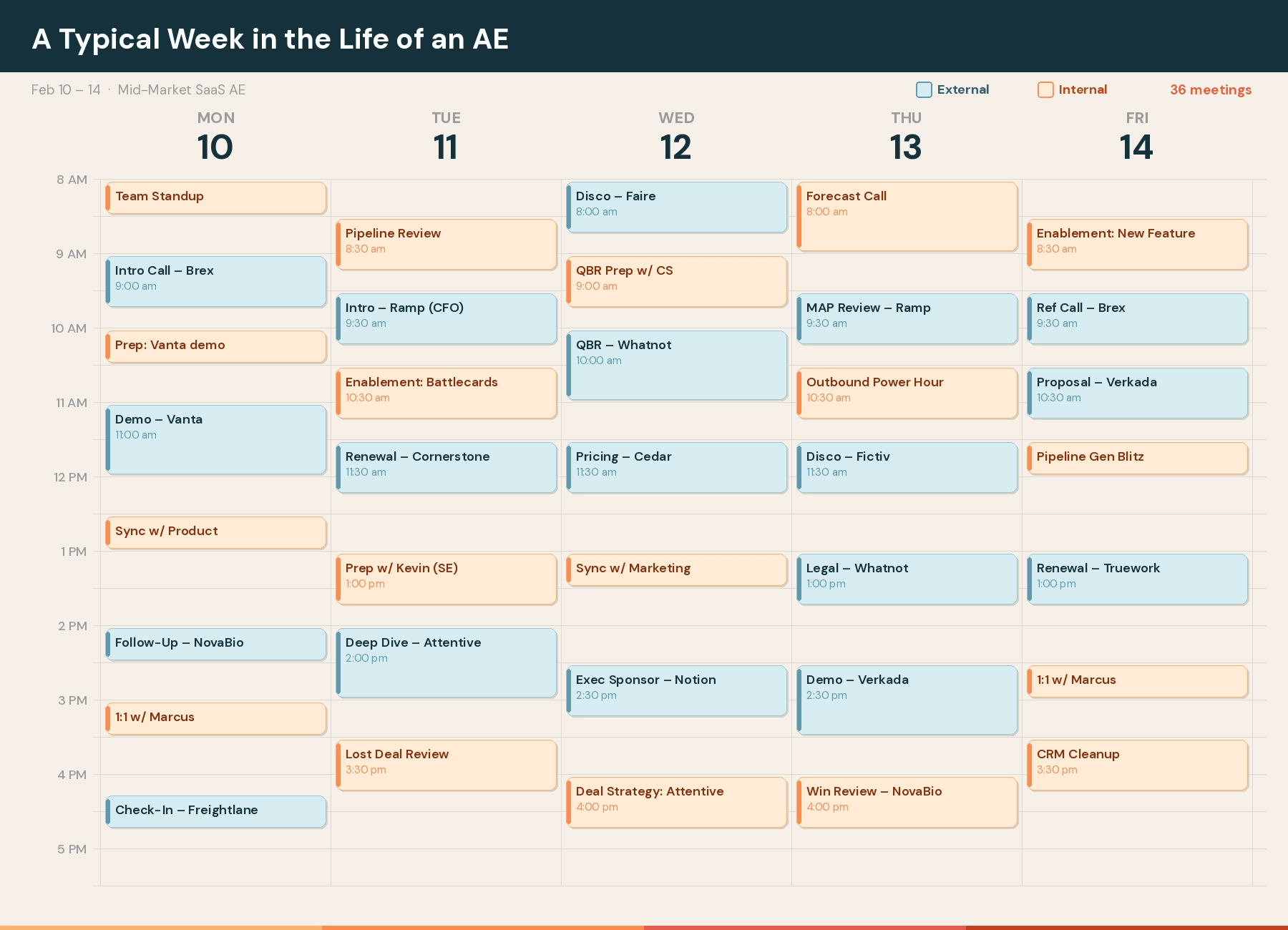
That's 36 meetings! And we're not counting the Slack huddles that pop up unannounced, the "hey do you have five minutes" calls, or the deal that blows up Thursday afternoon and suddenly needs an emergency strategy session.
If we break this schedule down to the meetings themselves, the time they take is legitimate. The demos and pipeline reviews and forecast calls are how the business runs, so you can't just delete half your calendar and call it fixed.
We believe the real problem is everything that surrounds each of those 36 blocks, which is the work that nobody budgets time for and nobody sees unless they're the one doing it. We’re going to walkthrough this together.
Before the Meeting Scramble
Let’s say an AE has a discovery call in eleven minutes with a VP of Sales they've only emailed twice and they just got out of a pipeline review where their manager asked about a completely different deal. The task at hand is context switching.
So here's what "prep" actually looks like:
Open Salesforce. Wait for it to load. Search for the account. Scroll through a wall of activity history trying to find the last touchpoint. Was it an email? A call? Did someone from CS log something?
Open Gmail. Search the prospect's name. Skim three different email threads to remember what was promised and by whom.
Open LinkedIn. Check the VP's recent posts and job history for something to reference on the call. Notice they just liked a post about a competitor. Make a mental note.
Open the shared Google Doc where someone (maybe) left notes from the last conversation. It's 14 pages long. Ctrl+F the prospect's name. Nothing relevant comes up.
Open a call recording device. Find the last call recording. Scrub through 38 minutes of audio looking for the moment they mentioned their budget timeline.
Realize the meeting starts in two minutes. Close three of the tabs. Wing it.
Now, if you multiply that scramble by the 15 to 20 external meetings on this calendar, that's hours of fragmented, unproductive searching every single week… or worse, it's meetings where the AE walks in cold and the prospect can feel it. (Neither outcome is good.)
During Meeting Split Brain
Once an AE is on the call, they need to be fully present in order to build the kind of trust that moves a deal from “interested” to “let’s talk through the next steps”. This means listening for buying signals, reading body language on Zoom and asking sharp follow up questions.
But while they're doing all of that, there's a second track running in their head:
"I need to write that objection down before I forget it."
"Who was the other stakeholder they just mentioned? I should capture that name somewhere."
"They just gave me a timeline. If I don't log this in Salesforce immediately, it's going to vanish from my brain by the next meeting."
"Am I taking notes right now or am I making eye contact? Because I can't do both."
This is the split brain problem, and every AE knows it. The quality of your presence on a call directly impacts whether a deal moves forward, however, the demands of documentation pull you out of the conversation at exactly the moments that matter most.
While the best AEs have learned to live with this tension, living with it doesn't mean it's not costing them.

After Meeting Admin Black Hole
After the call ends, an AE has about seven minutes, give or take, before their next meeting starts. Here's what should happen in those seven minutes:
Log detailed notes in Salesforce with next steps, stakeholder updates, and any changes to the deal stage.
Send a follow up email to the prospect summarizing key points and confirming action items.
Update the opportunity record with new timeline information, budget details, and competitive intel.
Slack the SE about a technical question that came up.
Flag for their manager that the champion just changed roles internally.
Sadly, what actually ends up happening is the AE joins their next call, tells themselves they'll catch up on notes later, and by 6 PM they have eight meetings worth of undocumented conversations sitting in their head but the details are already starting to blur together.
By the time they finally sit down to log everything, they're reconstructing from memory… and we hate to say it but memory, it turns out, is a terrible CRM.
The bottom line is there is literally not enough time in the day to run 36 meetings and do the admin that each one requires. The math doesn't work and it never has.
What This Actually Costs
When the meeting tax goes unpaid, it compounds into problems that show up in your pipeline, your forecast, and your retention numbers.
Follow ups land late or generic. When an AE can't send a crisp recap within the hour, the prospect's attention moves on. The competitor who follows up faster with better context wins. Not even because their product is better, but because they showed up sharper after the call.
Forecasts are built on stale data. That Thursday forecast call? It's running on opportunity data that's two or three meetings out of date, which means your VP of Sales is making resource allocation decisions based on information that was accurate last Tuesday instead of Thursday.
Your best reps burn out first. The AEs who care the most are the ones staying up until 10 PM logging notes and writing follow ups. They're not doing it because they love admin, but because they know what happens when it doesn't get done. This process is not sustainable, and those are the people you lose first.
Coaching stays surface level. Any weekly 1:1 is based on whatever the AE remembers to share, not on a complete picture of every conversation across their pipeline. The manager is coaching from a fraction of the data, and both of them know it.
None of this is new information to anyone who's worked in sales, but naming it matters, because it makes visible a cost that most organizations have just accepted as the price of doing business.

What If the Tax Just... Went Away?
This is the problem AnyTeam was built to solve. We don’t want to add another tool to the stack or give managers more dashboards. We are working to collapse the entire meeting tax so that AEs can spend their energy on the thing that actually closes deals: being fully present with buyers.
Before: You walk in ready with context
AnyTeam surfaces a complete pre meeting brief automatically that includes your deal history, last conversation highlights, stakeholder map, open action items, and recent account activity. This is all pulled together into one view before you even open the calendar invite so that when the call starts, you already know what was said, what was promised, and what this person cares about.
During: You stay in the conversation
AnyTeam captures the full context of every conversation in real time. You don't have to choose between listening and note taking anymore. Objections, budget signals, competitor mentions, next steps, stakeholder names, sentiment analysis: they're identified and tagged as they happen. You just focus on staying locked into the conversation and the deal intelligence captures itself.
After: The admin does itself
The moment a call ends, AnyTeam generates a structured summary with insights and drafts your follow up email. Our Sales Studio can also help you create any document that’s requested in the call in the matter of minutes. This way, that seven minute gap between meetings is now enough time to review, tweak, and send instead of starting from scratch. The 9 PM note logging session at the end of the day is officially gone!
If you’re ready to get your week back, AnyTeam works tirelessly across every meeting on your calendar so you don’t have to.
Copyright © 2026 Any Enterprises, Inc. All rights reserved.